Advantages of CNC Turning Services Across Parts and Industries
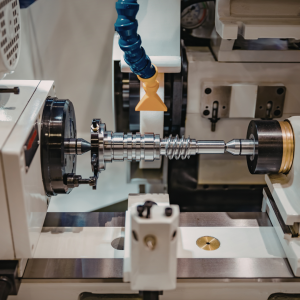
CNC turning is a form of machining with removes larger parts of solid material to form circular or cylindrical shapes, with its rotational cutting motion. This works by the tool rotating and the workpiece is remaining stationary.
CNC turning provides exceptional dimensional accuracy, making it ideal for manufacturing components that require tight tolerances. Turning produces smooth, consistent surfaces without the need for additional finishing. CNC turning also reduces manual labour and material waste, lowering costs for businesses.
CNC Turning offers custom solutions for unique projects and technicians can bring your designs to life with precise, symmetrical parts, mainly in cylindrical shapes, which are otherwise harder to achieve. CNC machines are programmed to cut and shape the material based on your specifications and using a toolpath and high speeds, components are perfectly shaped and smoothly finished. High-speed cutting and automated tooling changes lead to significantly shorter production cycles, which benefits the overall efficiency of your manufacturing.
A CNC Turning machine can work with a range of different materials from common metals, like steel, Aluminium and Brass, to engineering plastics, like Nylon and PEEK.
Industries that Benefit From CNC Turning
Aerospace
- High-strength, precision-critical components like turbine shafts and bushings
- CNC turning meets strict certification and tolerance requirements
Medical
- Surgical tools, implants, dental parts
- Requires high precision, biocompatible materials, and excellent surface quality
Automotive
- Engine parts, transmission components, pins, cylinders
- CNC turning supports high-volume, consistent production
Oil & Gas
- Valve components, drill bits, threaded pipes
- Needs strong materials and complex geometries
Electronics
- Connectors, enclosures, heat sinks
- Precise small parts suitable for mass production
What is CNC Milling?
Similar to CNC Turning, CNC Milling moves linearly, typically in three axes (X, Y, and Z), which allows the creation of square, rectangular, and flat features. Because this tool has an additional axis, it is given access to multiple sides and complex curves.